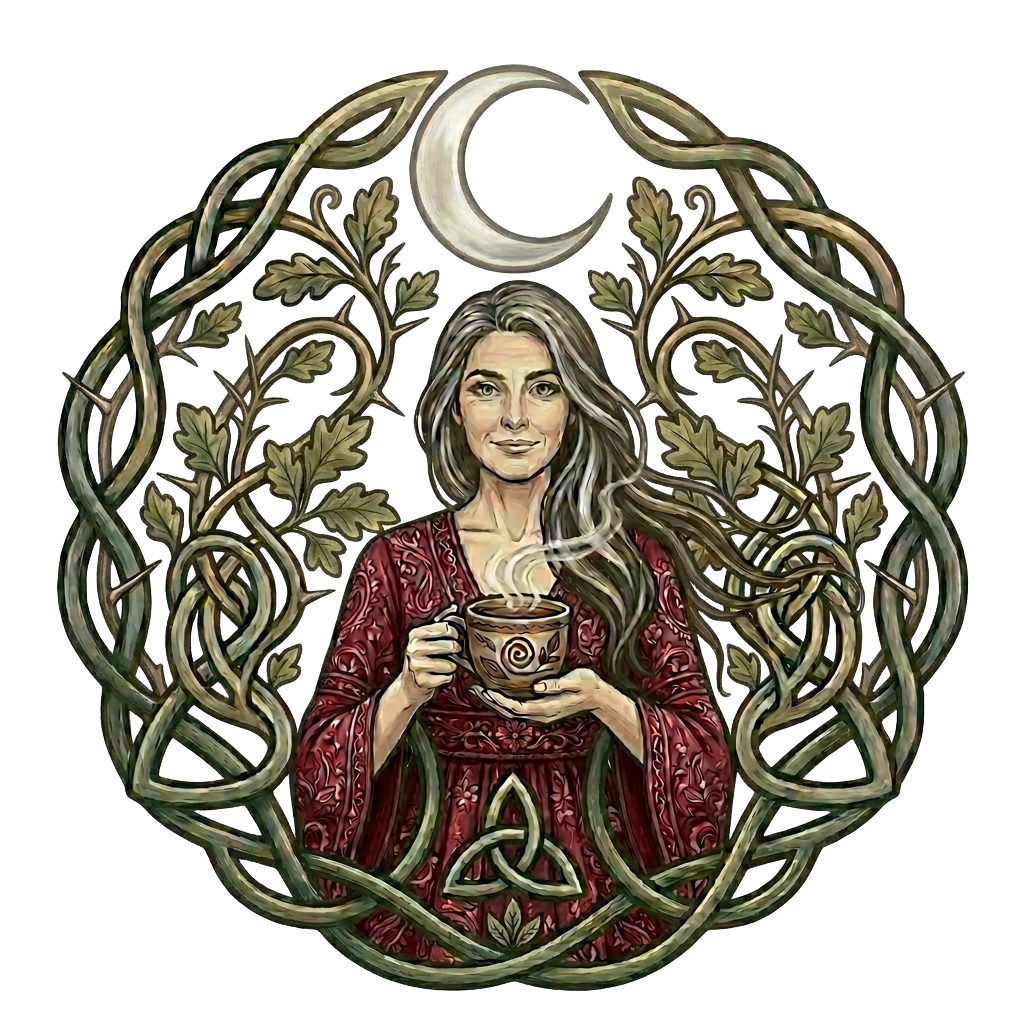
The winter mountain
She is the woman the world stopped asking from — and so, at last, she belongs to herself. This is the road less traveled. Often it is more of a challenge than a choice, for those who discover that the only way out is through and find the fortitude to endure loneliness and loss. It is a transformation borne of sacrifice and necessity, not simply a step on everyone's journey. Wisdom has a price.
The old story
In the Celtic world she is the Cailleach — the Veiled One, the hag of winter, the woman who shaped the mountains by dropping stones from her apron. She is feared and revered. She rules the dark half of the year, from Samhain to Bealtaine, when the world turns inward and the seeds learn their work in the dark.
She is not "the older Mother." She is something new. She has walked through losses — of parents, of partners, of children grown distant, of the body she once knew, of the self she once mistook for permanent — and she has come out the other side carrying something the village needed: perspective. The villages used to seat her at the head of the fire and listen. The villages knew.
Her joys
- Sovereignty — she no longer needs permission to be herself.
- A long view that softens the small dramas of the day.
- Compassion sharpened by her own descents.
- The freedom of having nothing left to prove.
Her challenges
- Invisibility in a culture that worships youth and productivity.
- The dissolution Jung called the Dark Night of the Soul — necessary, but lonely.
- Loved ones gone before her, and the silences they leave.
- The ache of carrying hard-won wisdom no one seems to ask for.
How we walk with her
This is the road less traveled. Often it is more a challenge than a choice — for those who discover that the only way out is through, and find the fortitude to endure loneliness and loss. Wisdom has a price, and the modern world has forgotten how to honor those who have paid it.
Hawthorn Moon is built first for her. Here, the Matriarch is not invisible — she is sought. Her stories are the firewood the younger women warm their hands by. Her quiet is welcome. Her grief is not pathologized. And she finds, perhaps for the first time in decades, other women who are walking the same dark and beautiful road.